

Lesser Magic IS Communication
By Warlock William Tull

The Communication Invocation
INTRODUCTION
“Double, double toil and trouble;
Fire burn and cauldron bubble.” - Three Witches, Shakespeare (Macbeth, 1623)
“Higitus figitus migitus mum
Pres-ti-dig-i-ton-i-um!” – Merlin (The Sword in the Stone, 1963)
“In nomine Dei nostri Satanas Luciferi excelsi!” - Anton LaVey, The Invocation to Satan (The Satanic Bible, 1969)
Magic. Defined by Merriam-Webster as “an extraordinary power or influence seemingly from a supernatural force.” Throughout history this has been manifested in a myriad of ways. Love potions and healing draughts from village witches. Communication with the spirits of our ancestors through Shamanic divinations. A certain Biblical figure walking on water and turning water into wine. In pop culture, there are no shortages of robed figures in pointed hats wielding wands and working for, or against, the powers of evil. Stage performers and illusionists cloak their routines in the mysterious and ethereal to mask their clever sleight of hand maneuvers. Since humans began to think and wonder, we have been enthralled by that which we do not understand, we have been obsessed with the supernatural and otherworldly. We are obsessed with “magic”, no matter what form it takes.
While the methods, motives, and markings of magic vary wildly through cultures and artistic representations, one thing remains constant throughout these depictions: the invocation. Be it carefully intoned inscriptions that must be spoken precisely and confidently, or ritualistic chanting from celebrants, or unholy pacts and offerings, the verbal components to any ritual, spell, blessing, or curse is vital.
Reflect on that. Think of any famous wizard, warlock, witch or magician. With very few exceptions, you can hear their words of power, be it in Latin, Aramaic, or some fantastical language. They all require a spoken word component in their castings. Satanic Magic is no different. Regarding Greater Magic, even a brief glance through The Satanic Bible or The Satanic Rituals you will see words to be spoken to ensure a successful and powerful ritual. Words that must be spoken boldly, confidently, to show power to the denizens of the Underworld. That is before approaching The Enochian Keys. Words are important to Greater Magic. Words are equally as important to Lesser Magic in the form of communication. In fact, effective communication is vital to Lesser Magic, without it you cannot hope to achieve the results you wish to see.
Magus Anton LaVey published the defining treatise on Lesser Magic, The Compleat Witch, or What to Do When Virtue Fails (1971) later reprinted as The Satanic Witch (1989).
This essay is in no way meant to alter or replace those foundational texts. In fact, I would venture so far as to say if you have NOT read it, stop here. Locate a copy, read it, understand it, and return here when you have.
The purpose presented in this text is to provide additional tools and insight to help reframe your approach to Lesser Magic, specifically how to achieve social manipulation and negotiation through effective communication. These tools have many practical purposes too, and once they become rote and instinct, you will see a major return on ALL social interactions in your life.
MINDSET
“All the world’s a stage.” – Jaques, Shakespeare (As You Like It, 1623)
For better or worse, we are always “on stage”. It is the human nature of social interaction that we wear masks, or play roles, in our day to day lives. We project who we WANT to be seen as. We often have different personas for who we are at work, at leisure, and in other social settings. The image we project at any given time has a purpose: it allows us to operate in that space efficiently and effectively to achieve the desired outcome. We all live double, triple, even quadruple lives based on our employment, hobbies, and other interests. You might dress smartly in business-casual attire during the work week, making small talk at the water cooler and proposals in the boardroom. On the weekends you might be found in cyberpunk outfits at warehouse raves, wearing false fangs and faux fur at goth clubs, or dressed in armor doing medieval reenactment. We ALL have these alter egos. The looks and locations vary wildly, but the song remains the same. We seek to integrate, to form bonds, and to earn the trust of those around us. There are many critics out there who would state they “are what they are” no matter where they find themselves. Even this “open book” mindset is a projection. It is a projection of blunt honesty; and like all projections it is meant to build trust.
These surface level dualities are fed and inspired by our inner “truer” selves. They are not over-compensation or shortcomings. These are not manifested insecurities. Societal expectations warn against being “fake”, while at the same time encouraging you to be bold, social, sexy, etc. I reiterate, there is NOTHING wrong with being multifaceted. It is more normal than you may realize; it is simply human nature. Especially when we begin interacting with each other.
It is these projections and personas we begin working with when it comes to effective communication. As we peel back the surface layers drill down into the levels beneath that our deliberate manipulation becomes truly potent in furthering our own ends. It is with this in mind that you must first understand your own projections. Take an honest stock of the masks you wear day to day, week to week, year to year. This might change in the moment, they might persist through the years, or they may become obsolete. All of this is normal and acceptable, especially when one no longer works for you. Embrace that which works, discard that which does not. This can be a challenge, self-analysis always is, but the more honest you can be with yourself, the more you stand to gain.
Once you begin to understand who you want people to believe you are, you can see the blind spots and the gaps you possess. Once these are identified, you can choose to fill them in or simply be aware of them, so you are no longer blindsided in the future. By identifying our perceived weakness, we can then focus on our strengths. Through this understanding we can find those blind spots in others. It is worth your time to seek others in your life you trust and ask for honest feedback in various areas of your life. Do you come off as unapproachable or intimidating? Do others perceive you as a push-over? Do you talk too much or make too many jokes at others expense? Blind spots are just that, and we need those pointed out to us, as hard as that can be at times.
In summary: The person you are talking to at any given point shows you who they want to be seen as. Using the tools outlined in this essay, you will be able to reliably identify who that person is, what motivates them, and how to most effectively communicate with them. It may not be immediately apparent, you might have to build trust and a relationship first, but even that starts with effective communication.
TOOLKIT
“Make sure that you always have the right tools for the job. It’s no use trying to eat a steak with a teaspoon and a straw.” – Anthony T. Hincks
Every practitioner of magic must have their tools. Think of this as the configuration of an altar. Each of these pieces must be studied for its place and purpose to be fully understood. Woe to the eager apprentice who tries to use these “sacred artifacts” without proper study!
The Platinum Rule
“Treat others the way THEY want to be treated.” – Credited to Robert P. Haffa, The Platinum Rule: A Concept of Persuasive Leadership (Military Review, September 1953)
There you have it, The Platinum Rule. For too long, as a society, we have operated under the famous Golden Rule: Do unto others as you would have them do unto you. Where this fails, is what we want often differs greatly from what other people want. In terms of negotiations, mediation, conflict resolution, or manipulation, you won’t make any progress by treating the other person as if they are you. You need to address the question everyone asks themselves: “What’s in it for me?”
In The Satanic Bible Anton LaVey modifies the Golden Rule to fit the core philosophy of Satanism: “Do unto others as they do unto you.” This is relevant and applicable in day-to-day life and should be considered separate and aside from the Platinum Rule.
This is the foundational tool; this is the first invocation to memorize and embrace. In terms of Lesser Magic and manipulation, this is bedrock. Any time you enter a social interaction where there is something to be gained (or lost), your first step should be to invite and entice the other person to the table by showing them why it is in their interests to do so. You must lead with the carrot, not the stick. Can you recall a time when this was used on you? Or when you used a method similar to this, either with friends or family?
With this invocation on your lips and this concept understood, now we must find out how that person wants to be treated. What motivates them? What are they seeking to gain? What gratifies them? How should they be spoken to?
Think back to when you heard two people arguing and needlessly going around in circles, when the answers seemed perfectly obvious to you. If you were to take the role of either side, how would you have guided the conversation to a more beneficial end? What compromise would you seek that would see you gain the results you need, but would also gratify the other party?
When time and resources permit, a little research goes a long way. If you are preparing for an interview or high-stakes negotiations speak to the other person’s colleagues or friends. Ask about similar subjects and how they have responded in the past. Study their past decisions and outcomes that came from it. In some cases, you may need to just approach them directly. It is vital to exercise cautions: no ones likes the idea that you are “asking around about them”. No one wants to be in position to show their hand before you show yours.
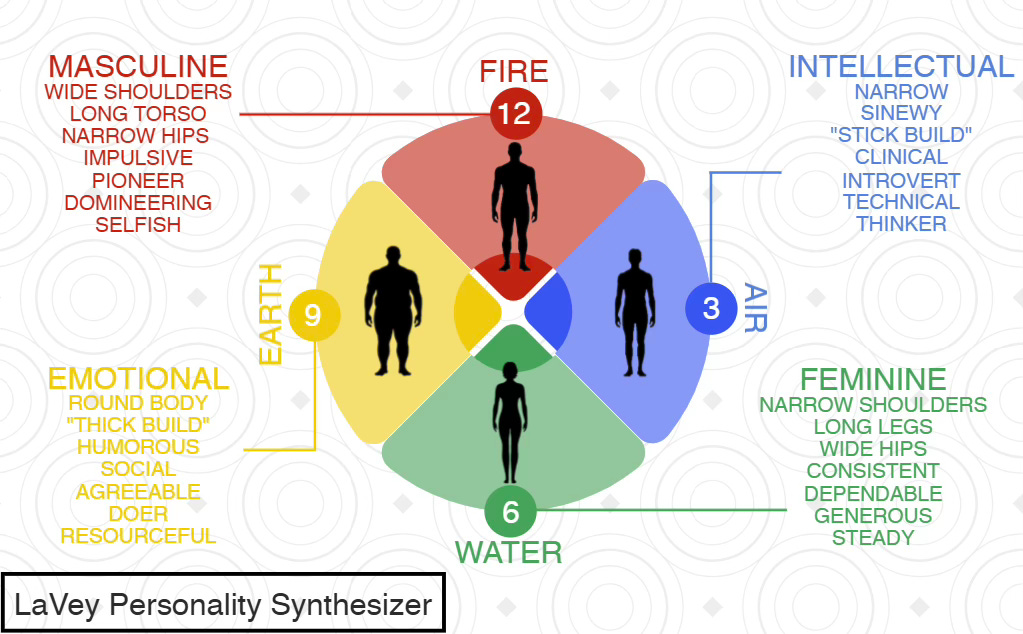
Lavey’s Personality Synthesizer Clock
“If a person wants to be hurt and enjoys suffering, then there is no reason not to indulge him in his wont.” – Anton LaVey
The Synthesizer Clock originally appeared in The Compleat Witch/The Satanic Witch and illustrates Anton LaVey’s expanded form of somatotyping. Somatotyping, for those uninitiated, is a theory that proposes that a person’s body type can be used to determine aspects of their personalities. The theory of somatotypes was developed by American psychologist William Sheldon, who published his theory in the 1940s. In Sheldon’s originating theory, there are three body types he established:
Ectomorphs: Defined by tall and slim builds with little to no body fat and finer bone structures. Often displaying more introverted and intellectual mannerisms which Sheldon defined as cerebrotonic.
Mesomorphs: Defined by muscular or athletic builds. Often displaying more confident and competitive mannerisms which Sheldon defined as somotonic.
Endomorphs: Defined by rounder, heavier bodies with wide waists and high body fat. Often displaying more social and friendly mannerisms which Sheldon defined as viserotonic.
In defining the synthesizer clock, LaVey established a fourth “Feminine” body type and in doing so, stripped the somatotypes down to their finer points. Instead of defining people by their body shape, measuring them in degrees along four opposing human types:
Masculine opposite Feminine (Top and Bottom or 12 o’clock and 6 o’clock)
Round/Social opposite Slender/Cerebral (Left and Right or 9 o’clock and 3 o’clock)
LaVey recognized that people most often exhibit different shades, or degrees of masculinity or femininity as well as body types, hence the “clock” configuration. Each personality type was also associated with a corresponding element and color: Masculine – Fire (red), Feminine – Water (green), Slender – Air (blue), Round – Earth (green).
The use of the Clock allows a person to determine a person’s outward personality and further allows you to identify their core personality and all that entails (wants, needs, etc.) Beyond the outward and core personalities, there is a third “demonic” personality that is ultimately a subliminal ideal of what we look for in a partner. This demonic type is often the opposite position of the Clock (A true masculine or 12 o’clock man, would be most attracted to a true feminine or 6 o’clock woman). A manifestation of the “opposites attract” philosophy. Identifying someone’s demonic self then allows you to identify their deeper more primal needs (Fetishes, Fears, etc.). The Clock can be used as a powerful tool not just to manipulate someone, but to completely dominate and bend them to your will.
Does the Clock work EVERY time? It is difficult to say. Some would argue that it is subjective, while others preach it as gospel. Your personal results and Clock Position might vary. Despite this, LaVey drew on dozens of sources when researching and writing The Compleat/Satanic Witch beyond Sheldon’s theory of somatotypes. He also allowed his extensive life experience and observations on human interactions to truly allow his work to stand apart from the sources. Regardless of the individual results, the science is sound, and the tool is useful.
This is, of course, a VERY brief definition of the Clock itself, to truly understand its full potential, I must emphasize again: go and read The Satanic Witch.
For purposes of this essay and the following tools, we will focus on using the Clock to identify a person’s body type, which will give you a glimpse of how to approach and engage them and the persona they are showing to you. Some people would call this a “cold read”, a technique used by fortune tellers and “psychics” to glean information from a person without knowing anything about them. Once you gauge someone’s Clock position, now you need to engage them. For this we’ll move on to the next tool in your kit.
Figure 1 - The LaVey Personality Synthesizer Clock
The DISC Communication Method
Originally developed by psychologist Doctor William Moulton Marston in 1928, the current DISC assessment and communication method is a modern analysis of the four basic emotions experienced by humans. Going back as far as 400 BC when Hippocrates defined the four Humors (Choleric, Sanguine, Phlegmatic, Melancholic) and again in 350 BC when Aristotle ascribed them to the four elements (Air, Fire, Water, Earth). The concept was further refined into Functions by Carl Jung in 1921.
In his book The Emotions of Normal People (1928), Dr. Marston centered on what he called the Primary Emotions: Dominance, Inducement, Submission, and Compliance (DISC), though the names have been modified since. He asserted in this theory that normal people had predictable responses to various stimuli. He posited that these behavioral types came from people’s sense of self and their interaction with the environment. Marston included two additional dimensions that influenced people’s emotional behavior:
First Dimension: Whether a person views their environment as favorable or unfavorable.
Second Dimension: Whether a person perceives themselves as having control or lack of control over their environment.
Though the titles changed, here is a brief summary of the four DISC descriptors with their current refined titles:
Dominance: Perceives oneself as more powerful than the environment and perceives the environment as unfavorable.
Influence: Perceives oneself as more powerful than the environment and perceives the environment as favorable.
Steadiness: Perceives oneself as less powerful than the environment and perceives the environment as favorable.
Conscientious: Perceives oneself as less powerful than the environment and perceives the environment as unfavorable.
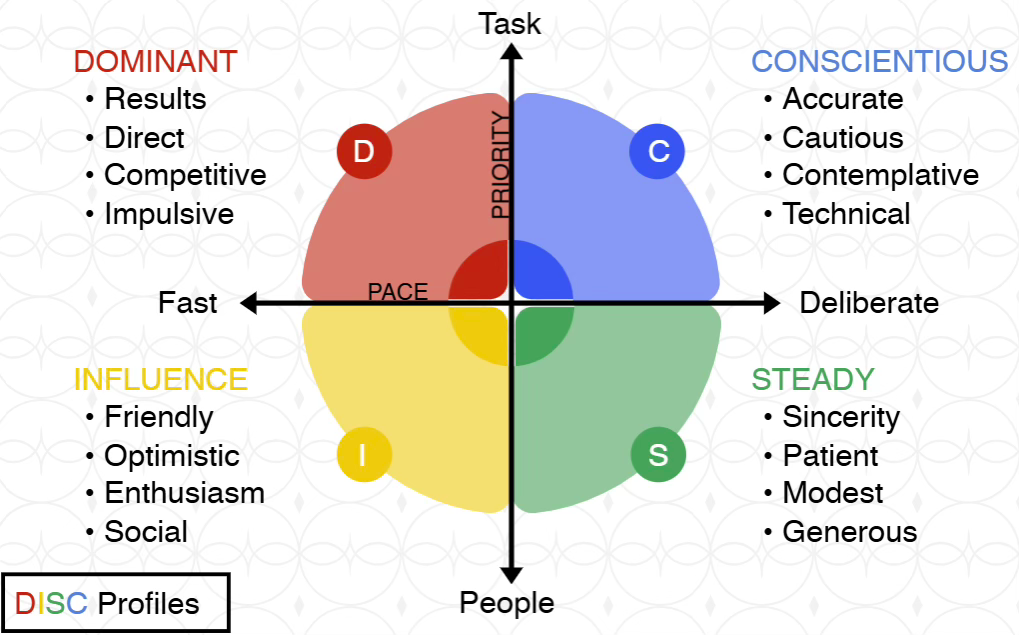
Through nearly a century of refinement, the DISC method no longer needs long periods of careful observation or speculation. We no longer need to identify how one perceives their environment, there are always clues that we can observe in real time, often within a few moments. Instead of focusing on how a person perceives their environment, or their place within it, we can match these perceptions to how they handle the Pace and Priority of their tasks. These are the two keys to power when using the DISC Communication method as it relates to Lesser Magic. By answering two Power Questions, you can approximate where they land on the DISC spectrum, and with this approximation, immediately begin communicating with the individual on their level, and in a way that they will be receptive to.
The Power Questions:
Pace (Fast or Deliberate): Do you want results fast, or should care be taken to complete them?
Priority (Task or People): Do the results matter more than the people involved in the process?
Once these questions are answered, we have a new (but very similar) rubric as it was originally established. It is from this rubric that you can begin to work your true Magic:
Dominant: Pace – Fast. Priority – Task. The Dominant communication style is always focusing on “the bottom line” or how to “win”. Spare the small talk and get right to business. Don’t sugar coat bad news and focus on the task at hand. The Dominant Communicator likely won’t care about the big picture or playing the long game. They are results driven and want to put “rubber on the road”. Dominant communication types are often leaders in organizations because of this full-steam-ahead mindset. Their weakness lies in their often-callous mannerisms and inability to truly motivate people around them without resorting to threats. The Dominant Communicator will appreciate a firm handshake and blunt, no-nonsense updates or plans for the immediate future.
Identifying quotes:
“How soon can you have that on my desk?”
“The ends justify the means.”
“I don’t need the whole story, give me the bullet points.”
Dominant Communicators from history:
Michael Jordan
Hilary Clinton
Robert DeNiro
Influence: Pace – Fast. Priority – People. The Influence communication style focuses on the people involved. These are the motivational speakers, the class clowns, the cheerleaders. The Influence communicator is often the easiest to work with and brings the classic “extrovert” mindset to any team. They are a great morale boost and natural public speakers. They hate stagnating or being bored and will often follow the adage “It is better to ask for forgiveness than permission.” The weakness of the Influence Communicator is they have a deep need for validation from the group and will often go out of their way to bring attention to themselves, often at their own expense. The Influence Communicator can be easily discouraged if they do not get the validation they feel they deserve. The Influence Communicator loves small talk, especially when they get to lead the conversation.
Identifying quotes:
“We nailed it today, Team. We should go get drinks! I know this karaoke place…”
“I think we can do it bigger and bolder!”
“This actually reminds me of a story. Back when I was in college…”
Influence Communicators from History:
Robin Williams
Chris Farley
Liza Minnelli
Steady: Pace – Deliberate. Priority – People. The Steady communication style focuses on supporting the hearts and minds of the people around them. These are our dedicated volunteers, our executive assistants, our “mother/father” figures. The Steady Communicator has a deep seeded need to provide for those around them. They will be the first to offer you water on a hot day. They usually carry extra Tylenol or snacks “just in case”. The Steady Communicator succeeds when the team succeeds, especially if they feel good about the results, and the methods used to achieve them. The weakness of the Steady Communicator is they all-too-often place the needs of others above their own, leaving them drained and burned out. They also struggle in leadership roles where they have to take charge without an opportunity to collaborate. The Steady Communicator enjoys making connections and getting to know people, as long as they are primarily listening and don’t need to interact too much.
Identifying quotes:
“We need to make sure we get input from everyone before we decide.”
“I’m going to check and make sure there are enough chairs for everyone.”
“If everyone is in the band, who is watching them play?”
Steady Communicators from History:
Martin Luther King Jr.
Halle Berry
Jane Goodall
Conscientious: Pace - Deliberate. Priority – Task. The Conscientious Communicator focuses on the process and procedures. These are our “bookworms” or technical experts. The Conscientious Communicator always comes prepared to meetings with charts, manuals, research, and an eye for the “big picture”. They are often more concerned with the systems and parameters, and less about the people involved. They often have an intense need to be factually correct and precise and will often hold up projects based on data points. Their weakness lies in their fear of being wrong or looking stupid/uninformed. They do not adapt well to surprises or rapid change. The Conscientious Communicator can often seem like a bore because they would rather talk about work or projects they are involved in, but this is because they take an immense amount of pride in seeing a project through with optimal results.
Identifying quotes:
“The current model is not sustainable at this level.”
“I’m not prepared to answer that until I get more information.”
“This isn’t working. Start again from the top.”
Conscientious Communicators from History:
Leonard Nimoy
Clint Eastwood
Bill Gates
As you read through this list, you are likely identifying key traits you recognize in yourself. You might recognize traits from two or even three of these communication styles. This is normal and natural. We ALL embody aspects of each style; however, we tend to gravitate strongly towards one or two. IT is a spectrum with very few individuals embodying the “textbook” example of these Communication Types. The key is to identify the primary type. Even in this spectrum we all have one key style that is stronger than the others. You might have to try multiple approaches to find it, and this technique is not a “paint by numbers tool”. Human beings are unique and varied, and as with the Synthesizer Clock, you will find exceptions to every rule, but that does not mean the rules don’t apply.
Think back on your recent social interactions. Did you have a time when someone cut you off mid-sentence because you were trying to provide important details that they didn’t think were necessary? Who in your social circle is happy to just listen to others talk and who is the one that always must have the last word? Is there someone at the office that needs hard data, numbers, and charts before they can have a face-to-face conversation? What about the people that you have a hard time reading and remain a mystery to you?
How can you adapt your communication style to match these individuals? Will one approach work? Or will you need to shift focus and style to achieve your goals?
In the day to day and moment to moment, depending on the circumstance, we might have to flex and shift through all the various styles. Regarding Lesser Magic and successful communication, it is imperative that you learn the styles and be able to adapt and flex, based on the person across from you. Ultimately, however, at our core our DISC style is a manifestation of who we are, our True Self, as referenced by the Synthesizer Clock. If you can harness this power, you can turn any meeting, collaboration, or interaction into a powerful opportunity to further your own goals.
It is important to note, as with the Synthesizer Clock, this is a VERY surface level explanation and examination. The barest tip of the DISC iceberg, so to speak. To positively identify your true DISC communication style, there is an in-depth assessment that can be administered by a licensed DISC Practitioner. Once this assessment has taken place, a true deep-dive examination of your DISC profile and the spectrum of how the profiles work with, and against each other can truly be seen. The best teams are often a balanced mix of all styles. The opposing styles often make the best pair ups, IF they can learn to communicate together effectively. If they cannot learn to overcome their differences, the results can be disastrous.
To practice this, begin with low-stake interactions with those around you. For the next week, find ways to use the Power Questions in normal everyday scenarios, for example:
When waiting for a drink at the bar, ask the person next to you: “Did you have to wait long for your drink?”
Their response will likely sound like one of the following responses:
“Yeah. On a night like this they need more bartenders.” – Dominant
“I didn’t really notice. I have all night and I’m here to party!” – Influence
“Yes. But I don’t mind, it’s just the one bartender and he’s doing his best.” – Steady
“As long as he gets my order right, I don’t mind the wait.” – Conscientious.
Be mindful that the actual choices of word and tone are going to vary wildly. In a perfect world, our interactions would play out just like we plan them in our minds. The reality is: that is rare. Be flexible, adapt, and don’t get discouraged when it doesn’t take flight immediately. Only time and practice can build a habit, and even the most seasoned veteran can be thrown off their game by the unexpected and anomalous.
You can find generic DISC assessments for free online but know that these results are at BEST a ballpark approximation of your true DISC style. Do not let this stop you from practicing and using the DISC method to enhance your Communication Invocation. Even this top-down view of the styles will benefit you going forward.
Figure 2: The DISC Communication Styles
The DISC Synthesizer
Now that we have laid the foundation and have our tools in hand, it is time to combine them into something pragmatic and useful. The diagrams provided above have many similarities. This was not artistic liberty, the colors, shapes and words used in both the Synthesizer Clock and the DISC Profiles are shown here as they are in their source materials. I did not alter them to fit the purposes of my essay. With a 45º clockwise rotation of the DISC Spectrum, you will see it overlays the Clock perfectly (Dominant at 12 o’clock. Steady at 6 o’clock, etc).
I have named this tool The DISC Synthesizer Clock that combines these tools to help you “cold read” anyone and begin working your Lesser Magic immediately.
Figure 3 The DISC Synthesizer Clock
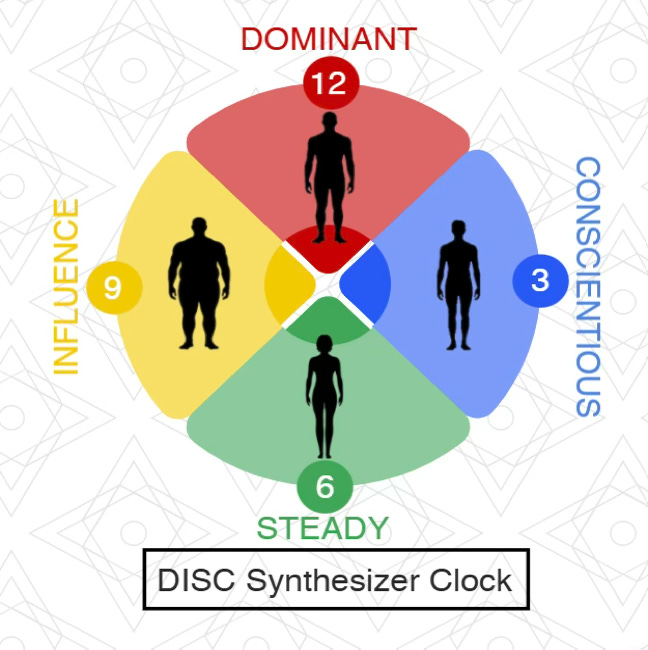
At first meeting, assess someone’s body type, assume their DISC profile, and begin your interactions. Use the power questions, or a variation thereof that suits the moment. Begin by evaluating their goals for the near future and estimate their pace in completing those tasks. This will help you identify if they are a Fast pace or a Deliberate pace. Then examine whether their priority is based on the Task or the People involved. Once you have established evidence to confirm their preferred DISC Communication Style, you have the keys to power. If there is any doubt, your best bet to start ANY interaction is going to be in the Steady Communication Style and adapt moment to moment.
Watch the people around you, listen to them speaking, and identify the power dynamics. Who is the leader? Who supports them? Who could be manipulated against them? Perhaps there is no clear power dynamic among them, and with a little work you could insert yourself into that position.
Challenge yourself to find people in your life that don’t fit into any of these somatotypes or communication types. How does your method and approach change? What continues to work, and what do you have to modify?
You will find that as you flex and adapt your own communication style to match theirs, trust begins to build. Reflect on times in your life when you met a total stranger, but within moments you found enough common ground that they felt like an old friend. That is the power of effective communication. It breaks down social and mental barriers faster than any gift or act of service. It endears you to the other person and they won’t even notice it is happening, but they will feel good about it.
We have opportunities all around us every day. If we watch, listen, and understand before we push to be understood. Once you are aware of it and can watch it happen, you can predict and control the outcome. Everyone around you will call it magic, and there won’t be any need to correct them.
CONCLUSION
In summary, based on the information above:
We all want to be treated the way we WANT to be treated. Find out what someone wants, before trying to exert what you want.
Our body type influences how the world sees us and interacts with us. This shapes our mannerisms and perceptions of the world around us. Traditionally “handsome/pretty” people are treated different than someone who is considered too fat or too skinny. Usually better by socio-economic standards. Use this to your advantage.
Both the Synthesizer Clock and the DISC Profiles are a spectrum with most people showing and sharing traits from adjacent areas. In short, there is no “one size fits all”. You must learn to flex and adapt on the fly.
Human beings are complex creatures. There will be anomalies to both diagrams, however the universal truth is that we all have things that motivate/demotivate us. We all have needs and desires.
Effective communication is a two-way relationship. If you want to be heard, often you must listen. If you want to be understood, seek first to understand.
Genuine human interaction is the best path towards manipulation and achieving your goals. If you are superficial, your motives will be uncovered, and your work undone.
With these key points in mind, you now have the tools you need to enhance your human interactions. Continue your study into the topics outlined here and learn from the masters that have come before us. There is no knowledge that is not power.
So it is done! Hail Satan!
ADDITIONAL RESOURCES
The Satanic Warlock (2017), Magister Dr. Robert Johnson - Dr. Johnson’s contemporary addition to The Satanic Canon not only expands on the principles of The Satanic Witch but adds new layers and concepts that are invaluable when discovering your Satanic Self.
Lesser Magic: The Personal Art of Shaping Perceptions (2025), Reverend Dr. Robert Ing
Advanced Lesser Magic: Advanced Subtleties for the Adversary (2025), Reverend Dr. Robert Ing – Dr. Ing provides practical methods for not only manipulating, but directing minds, implanting thoughts and ideas, and finding the value in awkward and tense silences that permeate powerful conversations. This two-part series is a must-read for practitioners of Lesser Magic.
How to Win Friends and Influence People (1936), Dale Carnegie – The preeminent book on how to navigate human interactions and build meaningful (and fruitful) relationships with the people around us, both at home and at work.
The Seven Habits of Highly Effective People (1989), Stephen Covey – The “gospel” works of self-improvement and self-empowerment. The works of Stephen Covey have endured through the years and become the gold standard for developmental leadership and how to maximize yours, and your teams, potential.
The Art of War (5 BC), Sun Tzu – The ancient Chinese treatise on war, tactics, finance, and how they relate and apply. Presented largely as a series of parables that, when applied to the modern world, show that no matter how much things change, the more they stay the same.
The 48 Laws of Power (2013), Robert Greene – A distillation of lessons, wisdom, and cautionary tales pulled from nearly 3,000 years of human history. Greene illustrated 48 specific laws to obtain, maintain, and restore power to oneself and their life.
The Gift of Fear (1997), Gavin De Becker – A book on the value of uncomfortable human instincts. De Becker examines the power and necessity for fear, and the place it holds in human evolution. Once you understand fear itself, it can no longer hold you back. By examining where fear comes from, and how useful a tool it is, we can master it.
The Way Things Work (1963), Simon and Schuster – A universal encyclopedia of machines and machinery. This might seem a strange addition to the list, but even a surface level understanding of simple and complex machines helps you understand the world around us better. By seeing how the various pieces fit together to accomplish their jobs, you are more confident in technical conversation. Not to mention the allegory of manpower and team dynamics should not be lost upon anyone practicing Lesser Magic.